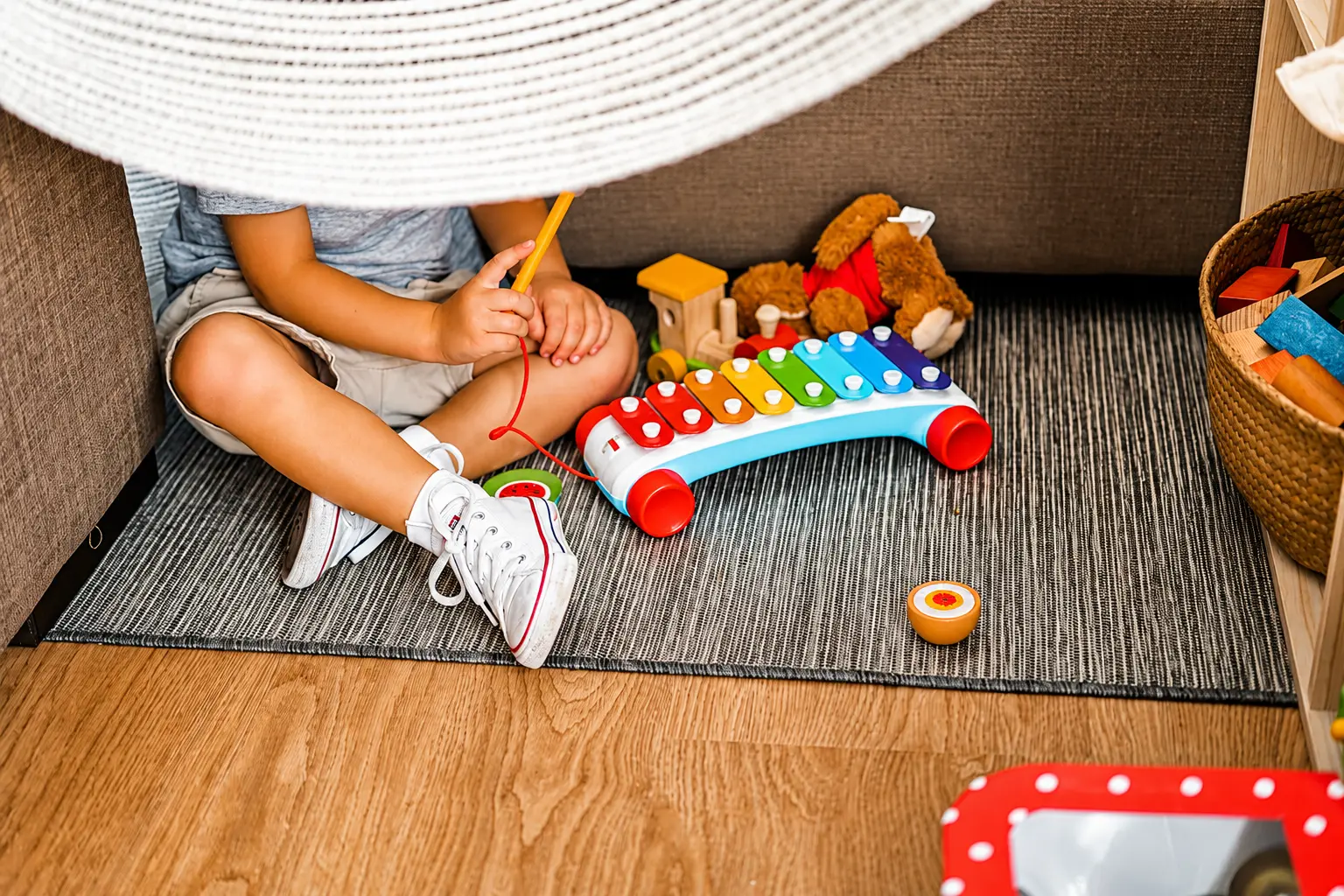
You’re at a playgroup and every other two-year-old seems to be chattering away while your child stays quiet, pointing and pulling your hand when they want something. Your pediatrician said to wait. Your mother-in-law says Einstein didn’t talk until he was four. But something in your gut says this isn’t quite right. If you’ve been asking yourself “is my child a late talker?”, the answer is worth finding out — not because there’s something to fear, but because early support makes a real difference.
Late talking is one of the most common concerns parents bring to speech-language pathologists. The tricky part is that some late talkers genuinely do catch up on their own, while others are showing early signs of a language delay, a motor speech disorder, or another condition that responds really well to early intervention. This post walks through the signs, the timeline, and how an SLP helps you tell the difference.
What Does “Late Talker” Actually Mean?
The term “late talker” has a specific clinical meaning: a child (typically between 18 and 35 months) who has typical development in all other areas — hearing, cognition, social skills, motor skills — but whose expressive vocabulary is significantly behind peers.
Late talkers are not the same as children with:
- A diagnosed language disorder
- Childhood apraxia of speech (CAS)
- Autism spectrum disorder
- Hearing loss
Those conditions can present with limited speech, but a late talker is specifically a child whose only area of concern is expressive vocabulary. They understand what you say. They play appropriately. They’re socially engaged. They just… aren’t talking much yet.
The key question is whether this is a temporary developmental variation or the beginning of something that needs support.
Speech and Language Milestones: The Baseline
Here’s a quick reference for typical expressive language expectations. If your child isn’t meeting these, it’s worth a conversation with an SLP — not a reason to panic, but a reason to get more information.
By 12 months:
- Says 1–3 words (in addition to “mama”/”dada”)
- Babbles with varied consonant-vowel combinations
- Imitates sounds and simple words when prompted
- Points to request or show interest
By 18 months:
- Uses at least 10–20 words consistently
- Points to pictures in books when named
- Follows simple one-step directions
- Uses words more than pointing/gesturing alone
By 24 months:
- Uses at least 50 words
- Combines two words together (“more milk,” “daddy go,” “big dog”)
- About 50% of speech is understandable to unfamiliar listeners
- Uses words for a variety of purposes: requesting, labeling, greeting, protesting
By 36 months:
- Uses 3–4 word sentences regularly
- About 75% of speech is understandable to unfamiliar listeners
- Asks simple questions (“where’s daddy?”)
- Can follow two-step directions
Not hitting these milestones doesn’t automatically mean something is wrong — developmental ranges are real, and children vary. But these are the benchmarks SLPs use as a starting point for deciding whether evaluation is warranted.
Signs That Go Beyond “Late Talker” Territory
Some patterns suggest more than a typical speech delay and are worth taking seriously sooner:
- No words by 16 months (even one clear, consistent word matters)
- No two-word combinations by 24 months (“more juice,” “go bye-bye”)
- Loss of previously learned words — a child who said words and then stopped
- Very limited sound variety in babbling — mostly vowel sounds, few consonants
- Inconsistent productions — a word is clear one day and completely gone the next
- No pointing to share interest by 14 months (not just to request, but to show you something cool — “look at that!”)
- Limited response to their own name by 12 months
- Predominantly gestural communication at 2 years (pulling, showing, but rarely attempting words)
- Unusual voice quality or pitch that doesn’t match typical toddler vocalizations
Any one of these warrants a conversation with your pediatrician and ideally a referral to an SLP. Multiple signs together make evaluation more urgent.
The “Wait and See” Problem
“He’ll catch up” is some of the most well-meaning but potentially problematic advice parents receive. For a small percentage of late talkers — often called “late bloomers” — that’s true. Research suggests that somewhere between 20–30% of late talkers resolve without intervention by age 3.
But here’s what the research also shows: you can’t reliably predict in advance which late talkers will catch up. And the children who don’t catch up on their own tend to go on to have language difficulties in school — reading, writing, following instructions, social communication — if they don’t receive early support.
The window between birth and age 5 is when language development is most plastic and responsive to intervention. Waiting costs something. A speech-language evaluation doesn’t commit you to anything — it gives you information so you can make a good decision.
What’s the Difference Between a Late Talker and a Language Delay?
A late talker is a descriptive term for where a child is right now. A language delay is a clinical finding based on evaluation.
When an SLP evaluates a late talker, they look at:
- Receptive language: Does the child understand words, follow directions, respond to questions?
- Expressive language: How many words does the child use? What’s the variety? Are they combining words?
- Play skills: Does the child engage in pretend play? Symbolic play?
- Social communication: Does the child make eye contact, share attention, communicate for different purposes?
- Motor speech: Are there signs of difficulty with the physical production of speech sounds?
A child can be a late talker with intact receptive language and great social skills — that’s a different picture than a child who is also behind in comprehension or showing limited social engagement.
How a Speech-Language Pathologist Evaluates a Late Talker
An evaluation isn’t a test your child can fail. It’s a collaborative process designed to answer the question: what does this child need?
A thorough evaluation includes:
- Parent interview — developmental history, concerns, what you’re seeing at home
- Hearing screening — hearing loss is the first thing to rule out
- Standardized language assessments — age-appropriate tests that compare your child to typical peers
- Play-based observation — how the child communicates spontaneously, in a natural setting
- Oral-motor examination — checking the structure and function of lips, tongue, palate
- Dynamic assessment — seeing how the child responds to cues and teaching moments
At the end, the SLP shares findings clearly: what’s typical for your child’s age, what’s below age expectations, and what the recommended next steps are — which might be monitoring, parent coaching, early intervention, or a full therapy plan.
What Happens If My Child Does Need Therapy?
An early intervention plan for a late talker typically focuses on:
- Expanding vocabulary through meaningful, play-based interactions
- Building the connection between words and their meanings
- Stimulating the child to attempt more verbal communication
- Equipping parents with specific, simple strategies to use at home every day
For very young children (birth to 3), therapy often looks a lot like guided play — because play is how toddlers learn everything, including language. Parents are always part of the picture, because the most powerful language learning happens in the hours you spend together every day, not just in a 45-minute session once a week.
For children showing signs of a motor speech issue like childhood apraxia of speech, the approach becomes more specifically motor-based and intensive. That’s why getting a thorough evaluation matters — treatment that matches the actual underlying issue is far more effective than a generic approach.
What You Can Do Right Now
Regardless of whether your child is evaluated or not, these strategies support language development in all toddlers:
- Follow their lead: Comment on what they’re looking at or playing with rather than directing them
- Get down to their level: Eye contact and shared attention are the foundation of communication
- Narrate your day: “I’m washing your hands. Cold water! Now we dry them.”
- Reduce questions, add comments: Too many “what’s that?” questions can feel like a quiz; modeling language (“ooh, a red truck!”) is more powerful
- Pause and wait: After modeling a word or phrase, pause and wait for a response — even 10 seconds feels long but gives toddlers time to process
- Read together daily: Books with simple pictures, repetitive text, and pointing opportunities build vocabulary and engagement
These strategies work in English, Spanish, or both — bilingualism does not cause late talking, and speaking your home language is always the right call.
Key Takeaways
- A late talker is a child whose only area of developmental concern is expressive vocabulary — all other skills are typically on track
- Key signs worth acting on: no words by 16 months, no two-word combinations by 24 months, words that disappear, very limited sound variety
- “Wait and see” has real costs — the early childhood years are the most responsive window for language intervention
- A speech-language evaluation gives you information and options, not a verdict — it’s always worth getting the picture sooner
Frequently asked questions
There is no single age at which concern automatically kicks in — it depends on the full picture. General guidance: if your child has no words by 16 months, no two-word phrases by 24 months, or if you’ve noticed words disappearing that were there before, those are signs worth following up on. Even if your child is at the younger end of typical ranges, if your gut says something is off, an evaluation is a low-risk way to get answers. Waiting “to see” without any assessment costs time in the window when intervention is most effective.
Pediatricians are wonderful partners in child health, but speech-language development is a specialty area. It’s not unusual for general guidance to be “wait and see” — and in some cases that’s reasonable. However, if you have concerns before age 3, especially with multiple signs present, you don’t have to wait. You can request a referral to an SLP directly, or contact an early intervention program (Florida’s Early Steps program serves children birth to 3). Getting information now doesn’t obligate you to any particular path.
This is a very common worry and the answer is no. The goal of speech therapy is always to build skills the child can use independently — and to equip parents to support communication at home every day. Many children who receive early intervention for late talking make rapid progress and are discharged from services well before school age. Therapy is a bridge, not a crutch.
Absolutely. Being raised bilingual does not cause late talking. Research consistently shows that bilingual children develop language on the same overall timeline as monolingual children — they may have slightly fewer words in each language separately, but their combined vocabulary across both languages is typically on track. If your child is a late talker and also bilingual, an SLP experienced in bilingual development (like we are at Thrive) can accurately evaluate your child in both languages and give you a clear picture.
“Speech” refers to the physical production of sounds — articulation, fluency, voice. “Language” refers to the system of words, grammar, and meaning — receptive (understanding) and expressive (using). A late talker typically has an expressive language concern — not enough words or word combinations. A speech delay might mean speech that’s hard to understand because of how sounds are produced. Children can have one, both, or neither — and an evaluation distinguishes between them clearly.